top of page

Ian Rowland Speaker Trainer Magician / Team building exercises
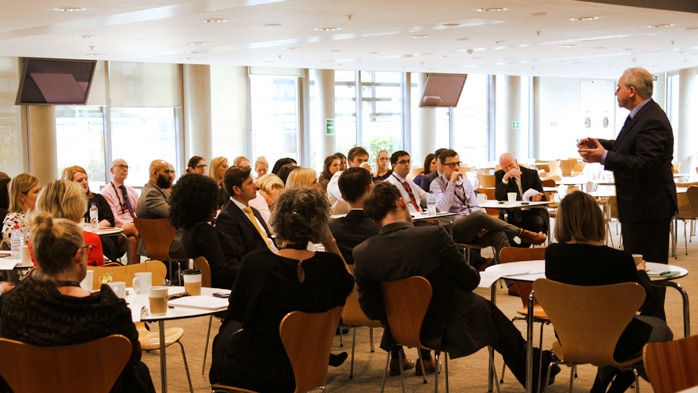
Ian Rowland Speaker Trainer Magician / At the Coca-Cola European HQ in Lisbon where I was hired to train their senior management

Team-building Exercises

I love taking part in team-building sessions or days. As well as being productive, they tend to be enjoyable and good fun for all concerned.


Here are just three things I've learned about making team building exercises and workshops a success.


(1) Fun is functional. The main thing I've learned about any type of training or coaching is that nobody learns anything when they're bored. This is why I believe every training session should involve elements of fun and humour. 'Fun' does not mean 'frivolous'. A session that's fun and enjoyable can still achieve serious, practical goals. I believe this also applies to team building workshops and events. When people play together well, they work together well.


(2) It has to be 'tailor-made'. Every company is different and every team or department is unique. For team-building purposes, I don't think a pre-set, 'off-the-shelf' course tends to work well. I always prefer to discuss the specific needs of the group or team I'll be working with and tailor the session accordingly. Among other things, I like to establish how interactive and participative you want it to be and whether there are key themes or messages that you'd like me to include.


(3) There's no such thing as too much preparation. People tend to enjoy events that feel well planned and organised, with care being taken to ensure, for example, that everything runs to schedule. This is why I believe in thorough planning and preparation — especially with regard to timings.


Most Popular Exercises

Ian Rowland Speaker Trainer Magician / Team building exercises
Ian Rowland presenting a training event at the STTAR Summit in Philadelphia

Here's my main page about my work as a trainer. Quite a few of the main subjects I teach lend themselves to team building exercises. The two most popular ones are:


Unlock Your Mind. This is all about discovering you can do more than you think you can do. For example, I present the whole room with a memory challenge. I ask various people how long it would take them to memorise the material I've shown. Everyone says it would either take them a long time or they couldn't do it at all. I then show everyone that they can easily memorise the whole thing once they know how. I follow this up with other demonstrations that work the same way — people think they can't do something and then discover that they can. The various challenges can be tackled in pairs, groups or teams.


Creative Problem-solving

Ian Rowland Speaker Trainer Magician / Team building exercises
Ian Rowland training business executives at a conference on the Isle of Man

Another good theme for a team-building exercise is 'Creative Problem-solving'. I teach six excellent and effective problem-solving stratehgies that anyone can use at work or in everyday life. I illustrate these six strategies using a range of puzzles and problems that seem tough at first — but become a lot easier when you apply the correct creative strategy. The various challenges can be tackled in pairs, groups or teams. I also relate the six strategies to famous business stories from the past that show the difference they can make.


Other Ideas

Ian Rowland Speaker Trainer Magician / Team building exercises
Ian Rowland training entrepreneurs at an event in London

I'd love to discuss the type of team building exercise you are looking for and suggest ideas. I have plenty of experience to offer and, as a trainer and magician, I can devise a wide range of exercises to keep any team happy, engaged and busy! www.ianrowland.com


***


Ian Rowland Speaker Trainer Magician / Team building activities
Ian Rowland Speaker Trainer Magician / Running a 'workshop' for Marks & Spencer

Team-building Activities

I love taking part in team-building sessions or days. As well as being productive, they tend to be enjoyable and good fun for all concerned.


Here are just three things I've learned about making team building sessions and workshops a success.


(1) Fun is functional. The main thing I've learned about any type of training or coaching is that nobody learns anything when they're bored. This is why I believe every training session should involve elements of fun and humour. 'Fun' does not mean 'frivolous'. A session that's fun and enjoyable can still achieve serious, practical goals. I believe this also applies to team building workshops and events. When people play together well, they work together well.


(2) It has to be 'tailor-made'. Every company is different and every team or department is unique. For team-building purposes, I don't think a pre-set, 'off-the-shelf' course tends to work well. I always prefer to discuss the specific needs of the group or team I'll be working with and tailor the session accordingly. Among other things, I like to establish how interactive and participative you want it to be and whether there are key themes or messages that you'd like me to include.


(3) There's no such thing as too much preparation. People tend to enjoy events that feel well planned and organised, with care being taken to ensure, for example, that everything runs to schedule. This is why I believe in thorough planning and preparation — especially with regard to timings.


Most Popular Activities

Ian Rowland Speaker Trainer Magician / Team building activities
Ian Rowland Speaker Trainer Magician / Training at a large Las Vegas confrence

Here's my main page about my work as a trainer. Quite a few of the main subjects I teach lend themselves to team building activities. The two most popular ones are:


Unlock Your Mind. This is all about discovering you can do more than you think you can do. For example, I present the whole room with a memory challenge. I ask various people how long it would take them to memorise the material I've shown. Everyone says it would either take them a long time or they couldn't do it at all. I then show everyone that they can easily memorise the whole thing once they know how. I follow this up with other demonstrations that work the same way — people think they can't do something and then discover that they can. The various challenges can be tackled in pairs, groups or teams.


Creative Problem-solving

Ian Rowland Speaker Trainer Magician / Team building activities
Ian Rowland running a team building session for Cap Gemini, London

Another good theme for a team-building activity is 'Creative Problem-solving'. I teach six excellent and effective problem-solving stratehgies that anyone can use at work or in everyday life. I illustrate these six strategies using a range of puzzles and problems that seem tough at first — but become a lot easier when you apply the correct creative strategy. The various challenges can be tackled in pairs, groups or teams. I also relate the six strategies to famous business stories from the past that show the difference they can make.


Other Ideas

Ian Rowland Speaker Trainer Magician / Team building activities
Ian Rowland hosting a training event at The Atomium, Brussels

I'd love to discuss the type of team building activity you are looking for and suggest ideas. I have plenty of experience to offer and, as a trainer and magician, I can devise a wide range of activities to keep any team happy, engaged and busy! www.ianrowland.com


***


Ian Rowland Speaker Trainer Magician / Cold Reading Techniques
Ian Rowland Speaker Trainer Magician / Teaching a small 'Cold Reading For Business' class in London

What Does 'Cold Reading' Mean?

First of all, let's define what 'cold reading' means. Then we can look at some of the techniques involved.


Every year, millions of people all over the world go for 'psychic' readings of one kind or another. The reading could be based on tarot cards, astrology, palmistry, peering into a crystal ball, graphology (i.e. a reading based on a sample of your handwriting), relaying messages from people who have 'passed over' (died) or some other divinatory system. People tend to go away from these readings pleasantly surprised, intrigued and astonished. Why? Because the person giving the reading is apparently able to make factually accurate statements about the client (the person they're giving the reading to) -- even though they are complete strangers. These statements could be about the client's personality and character or about facts and events in their life... past, present and future!

Afterwards, clients tend to say things like, "It was amazing! She told me things she couldn't possibly have known!" These apparently amazing results are why people all over the world enjoying going for readings and (in most cases) paying for them.

Techniques / Part 1

Ian Rowland Speaker Trainer Magician / Cold Reading Techniques
Ian Rowland Speaker Trainer Magician / This was the size of the 'opt-in' class for my all-day Cold Reading For Business' course at a Florida Conference.

How is the person giving the reading able to get these amazing results? If you want, you can believe that they have some type of psychic ability or that the system being used (such as tarot cards or astrology) actually works. I am not currently aware of any good reason to believe that (a) psychic abilities exist or (b) that any of these divinatory systems actually work. If you disagree, that's all right. It means we get to enjoy the warm, golden light of peaceful disagreement.


If you don't believe in 'psychic' powers, the alternative explanation is cold reading. The simple definition of 'cold reading' is 'how to talk to people so you sound psychic'. To go into slightly more detail, it's an elaborate set of techniques, based om shrewd communication psychology, that enable you to give the impression that you're making factually accurate statements about a stranger's life.


There are many cold reading techniques. In my book, 'The Full Facts Book of Cold Reading', which you can get from Amazon, I explain about 38 different techniques, in four categories: character, facts and events, the future and ways of subtly obtaining information. In this blog post, I can only give a few examples of cold reading techniques and how they might be used.


Techniques / Part 2

Ian Rowland Speaker Trainer Magician / Cold Reading Techniques
Ian Rowland teaching cold reading to a private client, one-to-one

One of the cold reading techniques for making a statement about someone's personality or character is called 'The Rainbow Ruse'. This basically involves crediting the client with both a personality trait and its opposite. Here's an example: "You can be a very considerate person, very quick to provide for others, but there are times, if you are honest, when you recognise a selfish streak in yourself." This cold reading technique works because most people are not 100% consistent, all the time, under all circumstances. However, if the person giving the reading delivers the line well, as if it's a remarkable insight provided by the tarot cards or astrological data, it can sound quite plausible and not too obvious.


Here's a cold reading technique pertaining to facts and events in the client's life. I call this 'The Childhood Memory': “In your younger years I get the impression of a particular interest or subject you were very keen on, where you showed lots of promise. I get a feeling that this was something on the creative or artistic side, where perhaps your parents felt you might go on to great things, but it was not to be.” This happens to be true for the majority of people, and is open to quite broad interpretation, but in the context of a reading it can sound quite plausible and not so obvious that it's trite.

My 'Full Facts' book lists several other types of statements that someone giving a reading can use to give the impression that they are somehow gaining profound insights into the client's life.


Techniques / Part 3

Ian Rowland Speaker Trainer Magician / Cold Reading Techniques
Ian Rowland working with two students during a cold reading class in London

A major aspect of successful cold reading technique is simply this: the client never knows what the 'psychic' would have said if they had given a different response. If the person giving the reading makes a statement that the client does not accept as a 'hit', it doesn't matter. There are several ways to convert what seems like a 'miss' into a statement that is a hit or at least not entirely wrong. I call these 'revisions' -- ways of being right even when you're wrong!


The simplest and most versatile of these is the 'Time' revision. It might sound rather like this:

'Psychic': I get the sense that you've recently been made aware of a new opportunity to do with your work and career. You got some news that has led you to consider quite a positive change in your work situation.

Client: No, not really. I don't think anything like that has happened.

'Psychic': That's all right. Well, if it hasn't happened yet then I get the feeling it could happen quite soon. Will you watch out for that? Because it could lead to some positive developments.


You see how this works: the 'psychic' made their statement in the present tense but, when it wasn't accepted, she just converted it into a statement about the future -- which, of course, can't be proved either right or wrong at the time the reading is in progress. It may come true later or it may not, but by then the reading is long since over. When I teach 'Cold Reading For Business', I mention seven different revisions in all. When you know how to use all of these revisions, you can make more or less any statement you want, about anything, knowing that you'll be correct or, if not, you can use a revision so that you're not entirely wrong.


This is only an introduction to cold reading techniques. It's a vast subject (which is why I've so far written three books about cold reading) and I cover it all in a short blog post like this. However, I hope this has been a usful introduction to what is certainly a fascinating subject. www.ianrowland.com


***


IR Logo.jpg

Ian Rowland.
Speaker, Trainer, Magician.

bottom of page